 Back
Back
A CHRONOLOGY OF WORK: Narrated by Nicola L.
A CHRONOLOGY OF WORK: Narrated by Nicola L.
Based on the unpublished memoir titled DIVE[1]
1. Early Years

Nicola at the École des Beaux-Arts, 1950s. Courtesy Nicola L. Collection & Archive and Alison Jacques © Nicola L. Collection & Archive
In 1950, Nicola L.[2] moved to Paris to study at the Académie Julien and subsequently at the École des Beaux-Arts. It was there that she met Fred Lanzenberg, a meeting that would profoundly shape both her personal life and her artistic journey. In the mid-1950s, Nicola and Fred married and settled in a former studio once used for decorative elements. The generous space allowed Nicola L. to fully explore her creative vision.
We live in the workshop. I paint large abstract canvases. F. [3]works in the decoration house of his uncle H. [4], it does not go well at all. He is often depressed and runs up against the despotism of the great decorator (moreover always charming with me socially) and F. builds, paints and organizes the workshop itself with talent and the little money we have. The gigantic size of the workshop allows me to work on large formats, sorts of abstract landscapes which I imagine are part of the space of the universe. After the very figurative teaching of Souverbie, I need to leave the human body and drown in space, the abstract. There is great loneliness in painting and that corresponds to my feeling of the moment (...) I sometimes feel trapped in a life of a couple to which I may not have been destined.

*All audio content has been AI generated. Source: quotes based on the unpublished memoir DIVE
[1] The Chronology of Work is based on the unpublished memoir titled DIVE, translated from its original French. The English translation was created for Nicola L.: Life and Art (Apartamento, 2023). It preserves the artist’s formatting and style, unless noted by square brackets.
[2] Nicole Jeannine Suzanne Leuthe, later known as Nicola L., was born in Mazagan, Morocco in 1932.
[3] Fred Lanzenberg (F.) was Nicola L.’s husband. He was a gallerist active in Brussels, where he founded Galerie Fred Lanzenberg in 1971. The gallery initially engaged with Pop Art—before aligning with currents such as Nouveau Réalisme and Narrative Figuration, in dialogue with critics including Pierre Restany and Alain Jouffroy. The gallery also supported key figures such as Marcel Broodthaers through editions and exhibitions. Remaining active until 2019, it constituted a significant platform for postwar and contemporary practices in Brussels.
[4] Henri Samuel, Fred Lanzenberg’s uncle who owned a decorative arts workshop in Paris.
2. How can we paint in the 60s?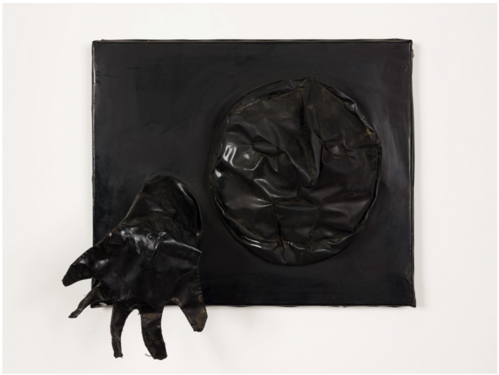
Nicola L., Black Head Pénétrable, 1964, vinyl, 38.1 x 47 cm. Courtesy Nicola L. Collection & Archive and Alison Jacques © Nicola L. Collection & Archive
In the summer of 1964, Nicola L. found herself in Ibiza, a place that shaped her practice and connected her to a community of international artists. Together with Fred Lanzenberg, she bought a house on the island that became her second studio. There she met Alberto Greco,[5] the Argentinian conceptual artist whose radical ideas challenged everything about art. Their conversations left a deep impression on her. In 1965, tragedy struck: Alberto Greco died. This event had a strong personal and professional impact on Nicola. According to her memoirs, she could still hear his doubting voice asking, “How can we paint in the 60s?” Driven by both grief and inspiration, she destroyed her abstract paintings, letting go of the work that no longer spoke to the urgency.
I find a large blank canvas, I pierce it with 5 holes for the head arms, legs and penetration as I thought I could do with doors ... and I sew kinds of sleeves which become an empty skin to penetrate, the "Penetrable" as Restany will call it in his essay A LONG JOURNEY TO THE END OF THE NIGHT[5*] in 1968 …
Back in Ibiza I continue this work of penetrable where the spectator can enter, where I can also enter and become the sky, the sea, the sun, the air etc...these are my new landscapes...it pays off to imagine being a part of the sun, the ocean, the Earth...this work brings me the peace that I needed after the shock of Greco …
I have a vague memory of 1965 of my first exhibition at Boulakia where I mix the first Penetrable and some paintings that escaped destruction after the death of Greco.
[5] Alberto Greco (born in 1931 in Buenos Aires, died in 1969 in Barcelona) was an Argentine conceptual artist associated with Nouveau Réalisme, known for his radical Vivo-Dito actions that declared everyday life as art, challenging institutions.
[5*] Nicola L. has cited the title incorrectly in her memoir [Life and Art, unpublished memoir text, artist’s archives]. The original title is A Long Day's Journey to The End of The Skin, essay published in Nicola, 1975. M HKA, Archive of Internationaal Cultureel Centrum (ICC), [International Cultural Centre], Antwerp
3. A Shared Living Artwork


Pink Cylinder, 1967, New York © Nicola L. Collection & Archive
The Pink Cylinder (1967) appears to be the first object activated as a performance. Nicola L. used objects as extensions of the body, transforming them into performative tools. In the Pink Cylinder, the object becomes activated through participation, blurring boundaries between sculpture, costume, and human body, emphasizing embodiment, interaction, and the merging of individuals into a shared, living artwork. The work was unveiled at the Fifth Biennale de Paris in 1967. The Pink Cylinder performance was later restaged at La MaMa in New York in 1968, in collaboration with Argentinian writer Copi.[6]
At the Paris Biennale …, I was part of the Graziella Martinez show, and produced a red vinyl cylinder in which the English group Soft Machine made a performance. Copi comes, with Victor Garcia and Elaine Stewart, the director of the LA MAMA theater in New York who invites me to come and do a performance with the cylinder in her New York theater in the coming months. Copi will write a text for the event...joy …
I do my performance at La MAMA Theater. Copi wrote me a text on childbirth which turns into a performance against the war in Vietnam, where my burnt dolls come out of the pink cylinder...
This period of 1966/68 passes very quickly... I am lucky to be in New York at the right time and age...(at the right time and at the right age ) I try to absorb everything, to see, to hear, a theme that I will take up in collages on my return SEE, HEAR, SCREAM, LAUGHTER, LOVE, SILENCE and DIE...I arrived at the time of the declaration of the Black Panthers by Stockly Carmichael, huge demonstrations against the war, Hippie movement, Feminism movement, incredible sexual liberation in such a puritan country, and we feel like the end of the sixties with the assassination of Martin Luther King in April 68.
I have to go back to France at the beginning of May 1968, partly to decide if F. and I continue, I organize a farewell picnic for friends in a place I like in Central Park.
The weather is nice, we are happy, sitting in the grass around a tablecloth with things to drink and eat, there are musicians playing near us...and suddenly a long parade of silent blacks crossing the park... they walk to protest against the assassination of Martin Luher King by a hired killer, the musicians stop playing, we remain frozen, sad, the party is over, yes, the sixties are over.
[6] Copi was an Argentine-French playwright, novelist, and cartoonist (1939–1987), known for his avant-garde, politically charged works that blended surrealism, humor, and social critique.
4. Functional Sculptures

Exhibition at Galerie Veranneman, Brussels, 1968, Courtesy Nicola L. Collection & Archive and Alison Jacques
© Nicola L. Collection & Archive
In 1968, Nicola L. worked in Ibiza, preparing her Hand and Feet sculptures for her first solo exhibition at Galerie Veranneman in Brussels. The following year, in 1969, solo exhibitions were planned at Galerie Templon in Paris and Galerie Kontakt in Antwerp, which showed Nicola: Sculptures Vinyl. Nicola L. developed the idea of “functional sculpture” (Functional Art) by merging art, design, and the human body into objects meant to be used rather than simply observed. She created works that operate as furniture—chairs, lamps, or cabinets—while retaining a sculptural presence. These pieces challenge traditional distinctions between art and utility, inviting physical interaction and turning everyday use into a performative, bodily experience.
I prepare during the summer an exhibition that I will have in October in the large Galerie Veranneman in Brussels … I do not yet know that I have just made my first functional sculpture...and that the 1/50 edition sofa feet will be shown at Galerie Veranneman in Brussels in 1968 and Daniel Templon in 1969 …
The exhibition in October 1968 at Veranneman in Brussels went well, and was a success. There are feet and hands of all colors, the pink cylinder, the penetrable, everything is about the broken body, inspired by my stay in New York … In Brussels, there are still good craftsmen with whom I can work and it is a positive period for me. In addition I found the complicity of working with F. with whom I can study certain projects … When I see on my resume that the exhibition after Brussels in October 1968 is Daniel Templon in 1969, I realize that my Lebanese misadventure is just after, Brussels, January 1969.
5. Fortune, Tarot, and the Other Way Around
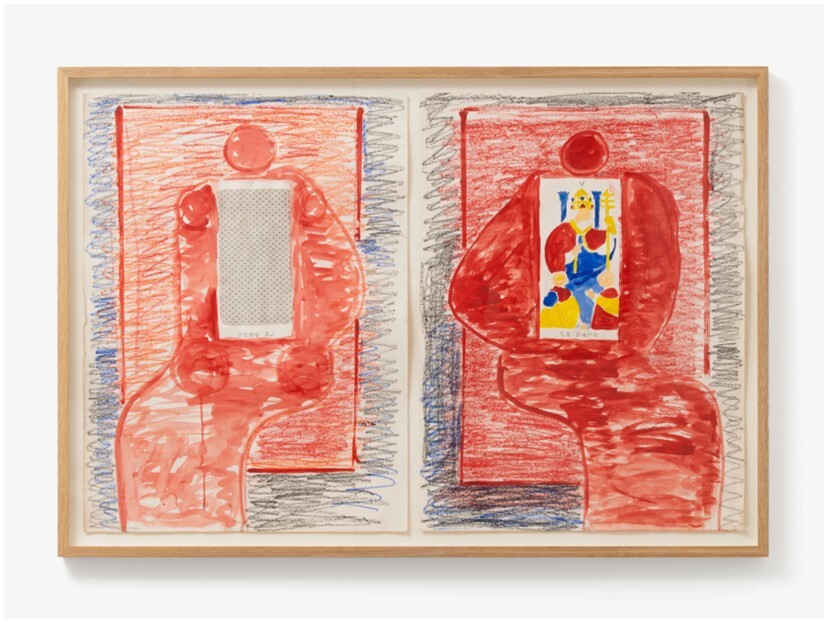
Nicola L., Serie Tarot - Le Pape, 1988, watercolour and pencil on paper, 76.2 x 114.3 cm Courtesy Nicola L. Collection & Archive and Alison Jacques, © Nicola L. Collection & Archive
In 1969, Nicola had a run-in with the authorities during her trip to Lebanon together with her American friends, who imprisoned her in Beirut for a couple of months. She started to sketch her graphic novels during her months in prison in 1969.
I can not tell everything because it could hurt some people including F. who was involved… We arrive at the women's prison where I will share the cell with two very young women, a Swedish and a Danish [woman] … They tell me about the prison...most women are killers, and almost all of them have killed their husbands...divorce does not seem possible for this class of society, even if they are mistreated, abused to the highest degree, they Receive 5 years in prison if the crime is not premeditated and double if it is. That is to say that the revolver or the knife as a murder weapon is cheaper to pay than the poison …
The next morning when I look with the other women - through the gate hole - the visitors arriving in the prison yard, I see F. walking with piles of books in his arms. I understand then that I will not leave any time soon… From the books he brought me, two very important ones to support this prison, a book on yoga that I will practice every day and another on tarot. I was already drawing the cards (I had learned the rudiments with this cook / cartementienne from my parents when I was 15 years old) . The tarot is a revelation for me, which will keep me very busy during these long idle days… I also begin to draw and write on a sketchbook HISTORY OF WOMEN'S HANDS AND MEN'S FEET WHILE THE EARTH TURNED INTO THE OTHER MEANING...which makes me quite a planner …
6. A Communal Garment

Red Coat performance in Antwerp, 1976. M HKA. Archive of Internationaal Cultureel Centrum. © Nicola L. Collection & Archive
In 1970, at the Isle of Wight Festival, Nicola L. conceived Same Skin for Everybody, featuring the Red Coat as a communal garment, for a performance with Brazilian musicians. Prior to the festival, she ceremoniously “baptized” the coat at Playa de las Salinas in Ibiza. Between 1970–76, the performance with Red Coat took place in multiple cities including Brussels, Amsterdam, Barcelona, Paris, Flaine, New York and Antwerp.
We are now in 1970, the only images / sound / memory are around the Red Coat, The Red Coat which will change my art and my life… (...) In the summer of 1970, I met two young Brazilians in Ibiza. They had brought with them several cassettes of very good Brazilian music, much of which was by Caetano Veloso and Gilberto Gil, whom I did not yet know of. They told me about a music festival that was going to take place on the Isle of Wight at the end of that summer and were planning to go there with Caetano and Gilberto... “Why don’t you come with us? Find an idea for a performance, we will be a group there, at least nine or ten... “. Before they left, I suggested the idea of a communal coat. This coat would be worn by eleven people - myself included. That way we would be protected from the cold, the rain, and also from getting lost... The Coat would be made out of plastic and would fit like a skin: “Same Skin For Everybody.” My two friends applauded the project with great enthusiasm and left the island shortly thereafter.
When I realized that this project would not be just a dream, I began to design the coat…. A rectangle measuring five by three meters with eleven slits to fit eleven hooded jackets. The part reserved for the legs would be communal, like an enormous skirt, allowing for free movement. Only the faces would be visible... I found a very shiny red vinyl fabric. I created the pattern, and together with my assistant we completed the giant coat.
Before leaving, I tried out the Coat (which would become the first of what I would later call “The Coats of Transformation”) in the Mediterranean on one of Ibiza’s beaches in Las Salinas, photographed by my friend the Brazilian photographer Carlos Rodriguez, then I left with him for Barcelona, from whence I would board the plane to England.
7. Everything Has a Skin, It's Life

Nicola L. inside La Chambre en Fourrure at Gallery Alexandra Monett in Brussels, 1975, M HKA, Archive of ICC (International Cultural Centre) © Nicola L. Collection & Archive
Between 1969 and 1970, Nicola L. developed La Chambre en Fourrure, a new form of wearable soft sculpture that functioned as both installation and participatory environment, presented in various venues across Europe, including Nicola’s solo show at ICC (International Cultural Centre) in Antwerp in 1976.
I design and make La Chambre en Fourrure for the Galerie Appolinaire in Milan in June 1970 on the theme of a community skin “Same Skin for Everybody”. I create it for 15 people and whose walls are made of body envelopes - empty humans in acrylic fur … The house is made up of empty figures that you can enter, envelopes of empty human bodies that you can penetrate. The ceiling is the only part that is not penetrable. It is the mirror, the dream … When a person enters a room, their gestural behavior is quite different from what it would be if he entered a wall. Everything changes completely: the movements of the arms, legs, head...a kind of release, improvisation. I am very surprised, sometimes to discover afterwards the identity of the people who have inhabited the wall or the floor … Skin is an obsession for me. The different skins, the sensations, the skin of things. Everything has a skin, it's life.
8. Pénétrables - A Wearable Sculptures

Nicola L., Terre, 1974 - 1978, M HKA/ Collection Flemish Community © Nicola L. Collection & Archive — Photo: M HKA
In 1975, during the solo exhibition Pénétrables, Bois & Soft at Alexandra Monett in Brussels, Nicola L. invited visitors into a world of playful interaction. At its center was La Chambre en Fourrure, alongside individual Pénétrables that could be taken off the walls and worn, thereby blurring the boundary between artwork and participants. The Bois et Soft series — wooden branches partially draped in fabric — evoked fragmented human forms, while works such as the Hand Sofa and Eye Lamp further transformed the gallery into an immersive environment where sculpture, design, and performance converged. This exploration of participatory and embodied experience continued in 1976 with Nicola L.’s first solo exhibition in Antwerp, Pénétrables, at the ICC.
In 1976 I continue in Ibiza my PÉNÉTRABLES which become banners of protest, whose requests are BREATHING, LOVING, LAUGHING, DYING, CRYING, SILENCE etc. taken up in a series of collages which resemble bandages ... revealing my state of thought. a kind of suffocation and wound I then have two major exhibitions in Belgium, a retrospective at the ICC in Antwerp directed by the formidable Flor Bex, and an exhibition of 60 international [artists] at the Museum of Ixelles JE / NOUS organized with the collaboration of Harald
Szeemann in favor of the Belgian newspaper Pour in 1975, which will be my last important exhibition in Europe. I am 40 years old.
9. Salto Arte

The only existing photo of Nicola L.’s performance during Salto Arte program. Exhibition Je/Nous, Musée d’Ixelles, Brussels, 1975. Catalogue for Je/Nous, M HKA Archive © Nicola L. Collection & Archive
In 1975, Je/Nous brought together a remarkable group of international artists at the Musée d’Ixelles in Brussels, exploring relationships between the individual (“Je”) and the collective (“Nous”). The exhibition featured works by figures such as Daniel Buren, On Kawara, Yoko Ono and Panamarenko, alongside Belgian and international contemporaries.
Running concurrently was the Salto Arte project, a collaborative effort organized with Harald Szeemann[7] and the magazine Pour, involving artists who contributed performances, prints and editions to support the publication and the circus-like programme. The event highlighted creative exchange, collective action and experimental practices within the 1970s art scene. Both the exhibition and the event were intended to save the left-wing magazine Pour from bankruptcy.
Harald Szeeman … decided that the time had come to organize a great event for contemporary art. The exhibition is called “Je / Nous”; it takes place in spring 1975 at the museum of Ixelles in Brussels. You could say that this exhibition is a great collection of the most stimulating creators of the decade: the list includes Carl Andre and Artschwager, Ben, Beuys, Boltansky, Buren, Byers ...Christo, de Maria, Filiou, Haacke, Immendorf, On Kawara...Le Gac and Lewitt...Panamenko, Pen and Polke, Arnulf Rainer Tinguely, Tuttle and Toroni... Among them Nicola, who takes part the next night in the hilarious evening under a circus tent erected in Brussels - event organized by several of the participating artists , evoking the Comte d'Orgel's Ball, a avant-garde cult circus of the 1920s, which in real time, like an arena of provocation, that artists of the 1970s did everything to go and see when they could…[8]
[7] Harald Szeemann (1933–2005) was a pioneering Swiss curator who redefined exhibition making, notably with When Attitudes Become Form (1969), championing Conceptual Art and establishing the independent curator as a creative author.
[8] Here in her memoirs, Nicola quotes a text by art critic Alan Jones.
10. Human Body, Collectivity, and Everyday Life

Nicola L. behind a giant Foot for the invitation for her exhibition at Galerie Daniel Templon, Paris, 1969. Courtesy Nicola L. Collection & Archive and Alison Jacques © Nicola L. Collection et Archive
Nicola L.’s vinyl sculptures, developed in the late 1960s and 1970s, transformed everyday materials into immersive, participatory artworks. Individual vinyl forms allow interaction, emphasizing the body as a shared and domestic space. With their tactile surfaces and pliable shapes, the vinyl sculptures reflect Nicola L.’s interest in human body, collectivity, and the integration of art into everyday life, challenging conventional distinctions between sculpture, performance, and design. She found in New York a fertile experimental environment that embraced interdisciplinary practices, allowing her to expand beyond the European avant-garde context. Living in the Chelsea Hotel[9] she connected with an international artistic community that supported the evolution of her practice toward film and more socially engaged work.
During her time in New York, she integrated her functional sculptures into her living environment, treating domestic space as an extension of her artistic practice. At the same time, she began to shift her focus toward filmmaking. Her sculptural works, meanwhile, increasingly assumed the status of commodity.
We arrive in New York in November 1979 again at the Chelsea Hotel communicated. I decided to stop all production of my sculpture objects, also called Functional Art, whose first piece was THE FOOT made in New York and after Brussels in 1967, followed by many pieces including THE EYE, THE LIPS, LA FEMME COMMODE etc...and the last two in 2009 THE ANGEL and THE WARRIOR lamps. The production of these pieces is obviously linked to relationships of money and trust with the galleries that represent me and I could not or didn’t know how to find the support I needed for this in my experiences over the past few years. I therefore stop all my projects in progress, especially the editions for which I had not signed a contract and which I consider canceled. I will therefore limit myself to my work of installations, film and writing, performances which brings me much more joy and creativity.
… I find a loft of 3000 sf on Broadway and 3rd street, completely empty, just the walls ... We build very quickly 3 bedrooms, kitchen and bathroom...everything is built so quickly here …The loft will be furnished with the functional sculptures exhibited at Waddel in 1973 and which were in a furniture repository, SOFA GIANT CORPS DE FEMME, BLACK BARTENDER, FOOT SOFA, PREVIOUS TELEVISION WOMAN, EYES AND LAMP MOUTHS etc...objects all made in the 60s and early 70s, which give a strange note to the loft of the 80s.
[9] The Chelsea Hotel was a legendary New York residence where artists, writers, and musicians lived, collaborated, and created, fostering experimentation, exchange, and a vibrant countercultural community throughout the twentieth century.
11. Thank You Marcel


1. Nicola L., Egg Round Table, 2008, wood, eggshells, plexiglass, steel, 76 × 102 × 100.5 cm. Courtesy Galila’s collection, Belgium © Nicola L.Collection & Archive
2. Nicola L. Red Lip Lamp,1969, plexiglass, steel, 129.5 × 71.1 × 6.7 cm, Courtesy Nicola L. Collection & Archive and Alison Jacques © Nicola L. Collection & Archive
The 2008 edition of Egg Round Table reflects Nicola L.’s friendship with Marcel Broodthaers and her admiration for other Belgian masters, including surrealist paintings of Magritte. The work carries a characteristic poetic and surreal spirit.
I saw Marcel Broothaers again in the sixties between Paris and Brussels. He had a hard time surviving as Belgian collectors buy American Pop but don't watch his work. Restany, to whom I ask for support so that he exhibits in Milan at Lenocci at the Apollinaire gallery, deaf, finds the work too intellectual. I'm trying to organize a dinner with a big collector who I forgot the name in Brussels, but it doesn't work. F. who has successfully opened his avenue Louise gallery produces an edition of Marcel CECI N'EST PAS UNE PIPE which I think is a success. It is thanks to Marcel that I create the eyes and the mouth lamps. When I show him the drawings of the objects in search of a factory to make them, he takes me to his plastic factory in Antwerp . These 2 objects, in different editions, have helped me to survive since my arrival in New York in 1979 ... thank you Marcel…
That's when I designed and had THE BARTENDER made – a big black man who doubles as a bar – inspired by Ricky, a very handsome Brazilian.
12. Heads

Portrait of Nicola L., circa 1992. Courtesy Nicola L. Collection & Archive and Alison Jacques © Nicola L. Collection & Archive
Nicola L.’s work is structured around a series of recurring thematic motifs. It develops a highly specific visual language in which body parts and dismembered forms occupy a central position. The motif of the head in particular recurs across a wide range of works — including drawings, films, and sculptures. This interest is notably reflected in her Super 8 film on Les Têtes d’Ibiza (The Heads of Ibiza) from 1977, conceived as a speculative and narrative inquiry into the island’s layered histories.
The recurring head motif present in the artist’s oeuvre is an existential response to personal crisis, transforming fragmentation, loss, and displacement into a unifying visual form that contains both body and landscape. The head becomes a psychic territory — at once wounded and generative — through which she reclaims identity and reimagines the self as an expansive, inhabited world.
The contour-profile - always the same - of a giant head started being my obsession in 1986. It came after a drama in my life (probably the only positive thing about crises is that they make you come out of yourself). So, in a "desperate state of mind", I started designing, with a piece of charcoal, a big profile of a head on a large piece of plain paper hanging on a wall.
The Head became so huge that the paper was not large enough, and I added a vertical strip of paper alongside it, on the right side of the profit, the slit between the two sheets looked like a wound. And when I applied a piece of tape to it, it then looked like a scar. But also, the important part of the profile - always the right side - the Forehead - Nose - Lips - Chin - Neck - became the coastline of the map of an imaginary country. Heads country.
And the design of this Head came naturally, without hesitation, as 1f I had done it 100 times before.. I thought that this charcoal head was going to be unique, but just after, I started a series of 6 oil paintings on paper, same size, same profile, with lettering inside: Air - Ocean - Sun - Wind - Night - etc. and progressively I couldn't see or create anything that was not inside the contour or in the shape of this head's profile.
13. Femmes Fatales

Nicola L., Femmes Fatales: Frida Kahlo, 1995,oil, paper and ink on cotton on painted wood, 193 × 193 cm. Courtesy Nicola L. Collection & Archive and Alison Jacques © Nicola L. Collection & Archive
Her return to painting led to the development of The Femme Fatale series (1995), composed of painted bed sheets incorporating photographic images and text. The works focus on women who met tragic or violent deaths, each figure evoked through a combination of visual and textual elements that frame their lives and destinies.
When I started the first series of "Femmes fatales” it rapidly became an obsession. I couldn't read anything except about those women, who were Cleopatra, Billie Holiday, Joanne d'Arc. Marilyn Monroe, Frida Kahlo and Madame Bovary. They were a group, a clan. I could see them everywhere, especially in the Headlines of the newspapers: “Lady with an attitude - witch. Bitch. Victim. Child. Murdered. Hooker. Beauty. Clever. Attractive. Trouble. Intelligent and Provocalite - Love. solitude. Rebellion. Rage. Politics. Magic .Search of Ecstasy. Cries and whispers behind a wall of silence. Stories. Dreams and Distortions - Fight. Death. Still alive. Femme fatale.” I was cutting all these words in the newspaper, putting them together, they become sort of poems. Each femme fatale could be represented by the same words arranged differently. There were now six paintings, collages, hung in my studio in a certain order that could not be changed. Each woman has her own colour. It seems to me that they were talking to each other. Didn't they have the same language I mean were they not made of the same words? Bitch, witch, victim, child, Eve? Then, this year I added three Femmes Fatales to the group. Eva Hesse, Urlike Meinhof and Mona Lisa. I made a new series by bringing all my previous works together. The woman-chest of drawers. "La femme commode” at the end of the sixties I made he woman-chest of drawers. Then a piece of furniture-sculpture. A chest of drawers shaped like a woman’s body – it was a protest against the objectification of women.
All parts of the body being used as drawers
The eyes
The nose
The mouth
The brests
The stomach
The womb
The sex
Twenty five years later, I have made a multiply in six different colours I feel the because they represent exactly what- the femme fatales did not want to be.[10]
[10] This quote is not part of Nicola L’s unpublished memoir Dive but from her personal notebook about the Femme Fatales series.
Back