 Back
Back
INTRODUCTION
This online platform has been created specifically for the exhibition Nicola L. — When the Earth Turned the Other Way, 25 Jun - 18 Oct 2026. It brings together archival materials, films, and essays reinterpreting key themes within Nicola L.’s artistic practice.
Nicola L. — When the Earth Turned the Other Way
25 Jun - 18 Oct 2026
Nicola L., Silence, 1972, Collectie M HKA, Antwerpen / Collectie Vlaamse Gemeenschap © Nicola L. Collection & Archive
“Skin is an obsession for me. The different skins, the sensations, the skin of things. Everything has a skin, it’s life.”
This statement by Nicola L., written while developing the participatory installation La Chambre en Fourrure (1970), captures the underlying logic of her artistic practice. For Nicola L., skin was a space of encounter—something shared, inhabited, penetrated, and transformed. Her understanding of skin extends beyond the human body toward architecture, objects, environments, and social relations themselves. Throughout her work, bodies recline, merge, disappear into collective structures, or inhabit sculptural forms together. Rejecting monumentality, verticality, and rigid individuality, Nicola L. instead proposes softness, horizontality, and participation as alternative ways of imagining both art and communal life.
The exhibition When the Earth Turned the Other Way brings together works by an artist who consistently challenged the boundaries between sculpture, performance, design, film, and lived experience. Working from the 1960s onward between Paris, Brussels, Ibiza, and later New York, Nicola L. developed a singular visual language rooted in collectivity, sensuality, and transformation. Her practice evolved in dialogue with the political and cultural shifts of the period: feminism, antiwar movements, experimental theater, Conceptual Art, and new forms of communal living.
Exhibition trailer: Nicola L. — When the Earth Turned the Other Way | M HKA
Video by Eyes-Screen
The exhibition focuses particularly on Nicola L.’s formative years in Belgium and France during the late 1960s and 1970s, a period marked by intense experimentation and close collaborations with artists, writers, musicians, and critics across Europe. Belgium occupies a special place within this trajectory. It was in Brussels and Antwerp that many of her iconic works were first exhibited and produced, often with the support of local artists and craftspeople. Her friendship with Marcel Broodthaers proved especially significant, shaping a shared interest in surrealism, poetic displacement, and the transformation of ordinary objects into carriers of unexpected meaning.
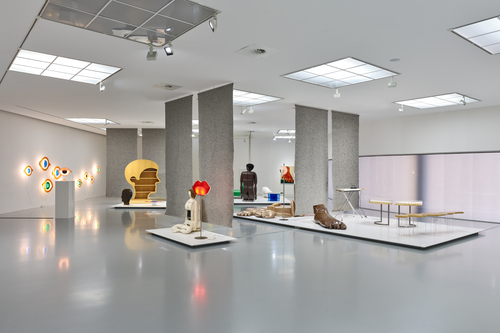
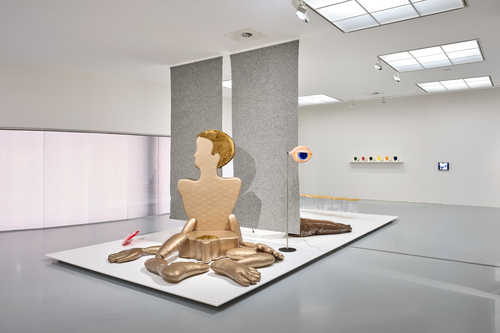
Nicola L.’s work consistently resists fixed categories. Her famous Pénétrables invited visitors to enter sculptures as though stepping into another skin, collapsing the distinction between artwork and participant. Functional sculptures transformed domestic furniture into anthropomorphic presences: feet became sofas, eyes became lamps, bodies became cabinets and communal spaces. These works destabilize conventional hierarchies between art and design, object and subject, utility and imagination. They also propose an alternative understanding of collectivity—one based on proximity, vulnerability, and shared experience.
A central focus of the exhibition is the performative exploration of the body. Her artworks often operate in the space between the public and the domestic, individual and collective; questioning how bodies inhabit social structures. Particular emphasis is placed on her engagement with the female body, approached not as a fixed identity but as a site of transformation, and political agency.
The exhibition title originates from a graphic novel Nicola L. began while imprisoned in Beirut in 1969. During this period of isolation and uncertainty, she started drawing a speculative story populated by wandering hands, feet, and fragmented bodies moving through desolate landscapes. The phrase When the Earth Turned the Other Way evokes a world that has lost its sense of direction—politically, emotionally, and physically. It suggests both rupture and possibility: a moment when dominant systems lose stability and other forms of relation begin to emerge.
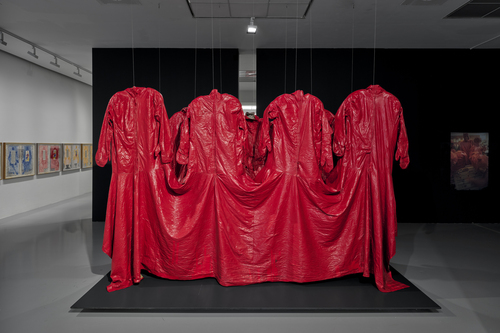
At the center of the exhibition stands Red Coat (1970), a communal garment created for eleven participants. The coat was sewn, “baptized” in the sea of Ibiza, and activated during performances across Europe. The work embodies Nicola L.’s vision of art as a shared experience. Describing the project, she wrote:
“The Coat would be made out of plastic and would fit like a skin: ‘Same Skin For Everybody.’”
The phrase captures the utopian impulse running throughout her oeuvre—a desire to imagine forms of togetherness that exceed social divisions while preserving individuality within the collective body.
When the Earth Turned the Other Way is more than a retrospective. The exhibition proposes Nicola L.’s work as a living proposition for the present: at once playful and radical, intimate and political, grounded in the belief that even the smallest gestures can transform the way we inhabit the world together.
In the visitors’ guide, audiences find a series of narrative captions based on memoirs written during the last decade of the artist’s life. In this way, the exhibition gives voice to Nicola L. herself, allowing her to explain the context behind the creation of selected artworks presented in the exhibition.
Nicola L. — When the Earth Turned the Other Way (teaser)
In conversation with Christophe Lanzenberg — When the Earth Turned the Other Way | M HKA
Video by Eyes-Screen
About Nicola L.

Nicola L. inside La Chambre en Fourrure at Gallery Alexandra Monett in Brussels, 1975, Courtesy Nicola L. Collection & Archive and Alison Jacques © Nicola L. Collection & Archive
Nicola L. (1932–2018) was a French artist whose practice rigorously questioned the boundaries between art, objecthood, and social relations. Born in Morocco and later active in Paris, Brussels, New York, and Ibiza, her nomadic life informed a transnational and communal approach to artmaking. From the late 1960s onward, she developed a distinctive body of work encompassing soft sculptures, environments, and participatory performances that foregrounded use, touch, and collective experience. While her work intersected with Nouveau Réalisme, it resisted categorization, articulating instead a feminist politics rooted in the activation of the body. Fragmentation, scale, and chromatic intensity recur as strategies through which bodies are multiplied, shared, or temporarily unified. Nicola L. ‘s work consistently proposed art as a lived, social process rather than a static object, anticipating later discourses around participation, relationality, and embodied spectatorship.
Curated by Joanna Zielinska
Courtesy of the Nicola L. Collection & Archive.
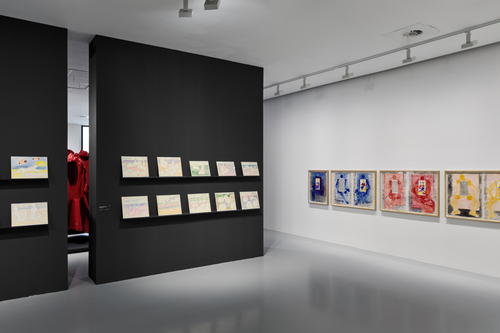
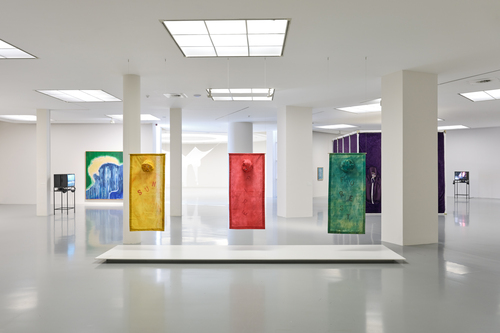
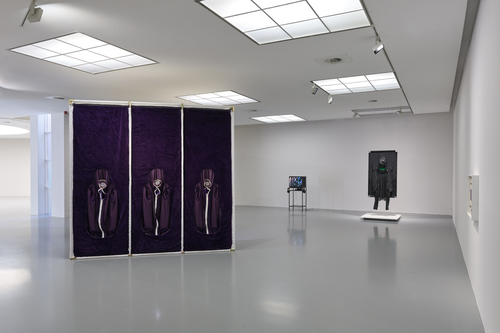
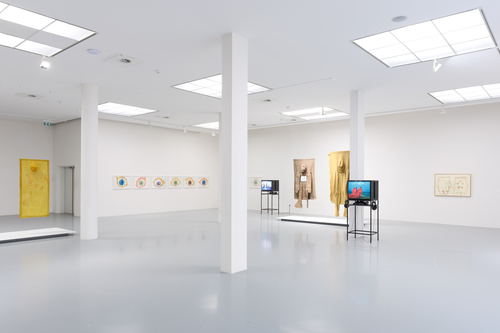
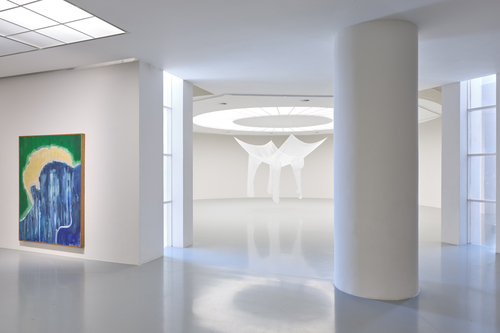
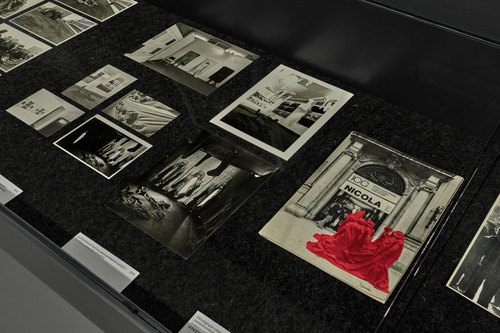
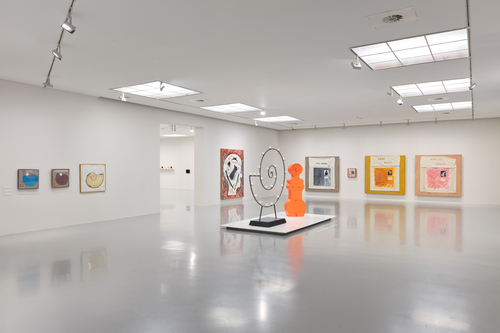
Installation views Nicola L. — When the Earth Turned the Other Way
© Nicola L. Collection & Archive — photos: We Document Art, 2026
Click here to download the exhibition brochure or continue to the next chapter
→ A CHRONOLOGY OF WORK: Narrated by Nicola L. →
*Cover images: based on original photographs of the Red Coat performance in Antwerp, 1976. Archive of the ICC. © Nicola L. Collection & Archive
Back