 Back
Back
BELGIAN CONTEXT
Entering the Skin: The Embodied Practice of Nicola L. in Belgium (1960s–1970s)
Essay by Annosh Urbanke, researcher at M HKA
In the mid-1960s, the artist Nicola L. (1932–2018) developed a series of works that would come to shape her career. During this time, the artist moved between New York, Ibiza, Paris, and Brussels. It was a period in which she created a distinctive way of thinking about physical environments that she built gradually. Drawings become sculptures, evolve into parts of spaces, and grow into entire spatial installations or even rooms. Her work and life circumstances eventually led the artist, after an extended stay in New York, to Europe. From 1969 onward, she lived and worked between Brussels, Paris, and Ibiza. Although she remained closely connected to these places, she eventually settled in New York in 1979.
Head to Toe
Nicola L. combines various parts of the body in her work. During her years of education, she took classes in sculpture, painting, and life drawing. Her teacher, Jean Souverbie, was a friend of Pablo Picasso and taught with a close focus on the human figure. While she initially focused on abstract painting—works that she later destroyed—she eventually concentrated on drawing the human body.[1] Her work focuses on the body and the playfulness of movement. In her memoir, she describes how she dances a lot and moves her body in crowds.[2]
The head is a motif Nicola L. explored early on and in various forms. In 1966, she created the two works, L´heure de la nuit and Homme de la nuit, with a completely blue and black head sticking out of a frame—a kind of sculptural distortion of the canvas. These works anticipate her Pénétrables series—frames you could enter and physically engage with. This concept of interactive pieces, like banners, rugs, capes, and environments, was something she expanded in a larger series of Pénétrables but also as a concept for performances.
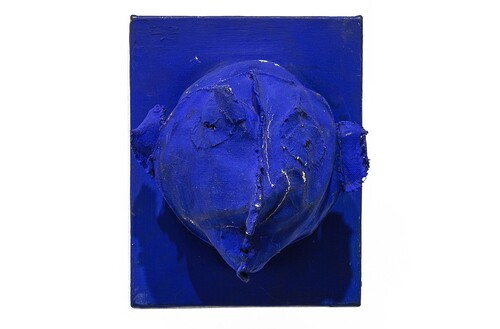
Nicola L., L´heure de la nuit, 1966, oil on canvas. Galerie Nec – Nilsson et Chiglien, Paris © Nicola L. Collection & Archive — photo: M HKA
It began, however, with the dimensions of a head coming out of a frame. A few years later, her drawing Merci Monsieur Magritte (1970) depicts the variation of a profile of a long-haired figure with an eye for a mouth, lips for eyes, and a separate sticker attached that reads “Merci Monsieur Magritte.” The words refer directly to the Belgian surrealist painter René Magritte and perhaps even more directly to his work The Beautiful Relations (1967). In his work a facial structure consists of a nose, lips, an eye, and a hot air balloon as an eye—floating and without contours. Unlike Magritte, Nicola L.'s work Merci Monsieur Magritte sketches the profile of a head. An eye replaces the lips and the lips represent the eye, set against the horizon and the sea. The work was created at a time when similar ideas were emerging. In hindsight, consideration of both this early phase and her larger body of work suggests that Nicola L. was influenced by surrealism.


Nicola L., Merci Monsieur Magritte, 1970, coloured felt pen on paper, Galerie Nec – Nilsson et Chiglien, Paris © Nicola L. Collection & Archive — photos: We Document Art, 2026
Nicola L. developed the subject of the head into a more complete three-dimensional form. In the spring of 1970, she exhibited White Is White and the Perspex Table tête blanche at Galerie Withofs in Brussels as part of the group exhibition Jeux de blancs. The gallery was completely white, and the works and staff were dressed in the same colour. The motif of the head persisted through the 1990s and 2000s, taking diverse forms: in drawings and collages, rendered in Perspex (Tête Cultivée, 1970), transformed into cabinets (Library Head, 1970–2013), and as a sofa (Canapé Tête, 2001). In the same year that Nicola L. created her Table tête blanche (1970) in Galerie Veranneman, Niki de Saint Phalle also created her work Tête Blanche (1970). This engagement manifested itself in multiple forms in Nicola L.’s works and it can be argued that engagement with corporeal elements was a defining interest of the period.
[1] Alan Jones, Invitation au Voyage: A Profile of Nicola and her Art, 1986. M HKA, Archive of Internationaal Cultureel Centrum (ICC), [International Cultural Centre], Antwerp
[2] Nicola L., Life and Art, unpublished memoir text, artist’s archives.


Nicola L.'s exhibition at Galerie Veranneman, Brussels, 1968. Courtesy Nicola L. Collection & Archive Alison Jacques © Nicola L. Collection & Archive
From 1969 onward, Nicola L. lived in Brussels with her husband Fred Lanzenberg and their son Christophe. Few years later, their second son, David, was born in Paris in 1971. Nicola L.’s first Belgian solo exhibition, Vinyl, took place in October of 1968 at Galerie Veranneman in Brussels. Installed throughout the gallery, there were eighteen works—a red bed shaped like a woman with feet and hands in different colours showcased against the wall, on the floor, and leaning against a wall. She showed the work Cylinder (1966)[3] and a selection of her Pénétrables. Inspired by her stay in New York in the late 1960s, she started working with the idea of the body. In her first experiments, she sewed a massive leg-column out of vinyl. Through this process, she developed functional sculptures: she did not want to create objects that were not meant to be used, but at the same time she did not want them to be merely decorative.[4] It started in 1968 with The Red Foot, a giant soft foot, which she exhibited as a sofa.[5] She continued with a series of life-size vinyl hands and feet during her stay in Ibiza. In her memoir, she describes how in Ibiza she got rid of a certain rigidity so that her body became more present in her work.[6] She exhibited the series of foot sofas for the first time at Galerie Veranneman.[7] The exhibition’s announcement mentions the artist’s wish
That people not only observe her sewn vinyl sculptures, but also step inside them. [8]
Here, the initial notion of touch emerges. She exploits vinyl as a substitute for skin. Vinyl has a similar smoothness, and when scaled to human size it takes on a different quality and becomes tangible in combination with absurdly large dimensions. This exhibition at Galerie Veranneman marked a key moment for her in Belgium.
During the same period, her husband Fred Lanzenberg worked between 1968–69 as a gallery director at Rive Gauche, an antiques and interior design shop that he gradually transformed into an art gallery. From around 1972–73, he opened his own gallery, called Fred Lanzenberg.[9]
[3] This performative work was first shown at the Biennial and International Exhibition of Young Artists in 1966 with the English group Soft Machine. Shortly after, she was invited by Elaine Stuart to come to New York and work with La Mama.
[4] Nicola L., in Profile Nicola L., ed. David Benaym (E-Maprod Inc., 2005).
[5] Interesting in this regard is Gaetano Pesce's work Up-7 Foot from 1969, which is made from very different material but is reminiscent in size and spatiality to Nicola L's foot series, for which she made sketches in 1967 and first produced one year later in 1968.
[6] Nicola L., Life and Art, unpublished memoir text, artist´s archives.
[7] Newspaper clipping on this matter in the Belgian Official Gazette, October 23, 1968. M HKA, Archive of Internationaal Cultureel Centrum (ICC), [International Cultural Centre], Antwerp
[8] Nicola, Kunsten Cultuuragenda, 1968, 10, 23. M HKA, Archive of Internationaal Cultureel Centrum (ICC), [International Cultural Centre], Antwerp
[9] The gallery was initially on Avenue Louise in Brussels. In 1976, the gallery moved to Avenue des Klauwaerts in Ixelles, where they also lived. Among Nicola L. (1974), Fred Lanzenberg exhibited artists including Niki de Saint Phalle and the French Nouveau Réalistes.
After this, the fragmented body parts make their way to Antwerp, and in February 1969, Nicola L.’s solo exhibition Sculptures Vinyl takes place in Galerie Kontakt. The gallery was active between 1965 until 1978 and run by Guy Schraenen and Anne Marsily. They focused on artists’ publications and upcoming international avant-garde and independent art movements from the late 1950s until the late 1970s.[10] Guy Schraenen visited the exhibition at Galerie Veranneman and invited Nicola L. to exhibit in Antwerp.[11] Galerie Kontakt was first located on Hendrik Conscienceplein and moved shortly before her exhibition to Kaasrui, which made her one of the firsts to exhibit there. The archive of Schraenen holds a sketch that she made for the invitation. In the documentation of this exhibition, one of her foot-sofas appears with a telephone on top, while the documentation of her exhibition Nicola at Galerie Daniel Templon in Paris in 1969, shows how people lounge on the large foot-sofas. The works did not stand statue-like in Galerie Kontakt; rather, the spatial works gave the surroundings a completely different feel. Nicola L. created her own world in which people are invited to interact and live. In fact, Vital and Stéphane Schraenen, the sons of Guy Schraenen and Anne Marsily, recall that one sculptural vinyl foot stood absurdly and prominently in their bedroom for a while.”[12] Nicola L. enlarged the body to be invasively present, making it physical and tangible. The public experienced this in variations of fabric and format.


Silver hand sofa and telephone & Foot and telephone during Sculptures Vinyl at Galerie Kontakt in 1969, Antwerp. Courtesy private collection © Nicola L. Collection & Archive
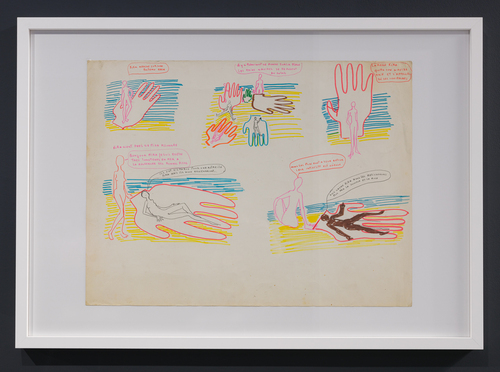
Sketch for the exhibition invitation of Sculptures Vinyl at Galerie Kontakt in 1969, Antwerp. Courtesy private collection © Nicola L. Collection & Archive — photo: M HKA
In the same year that Nicola L. developed her works Red Lip Lamp and Blue Eye Lamp in Antwerp. She became friends with Marcel Broodthaers and he invited her to where he probably produced his series of Plaques (1968–72):
It’s thanks to Marcel Broodthaers that I create the Red Lip Lamp and Eye Lamp. When I show him drawings of the objects, searching for a factory in which to make them, he takes me to his plastic factory in Antwerp. These two objects, in different editions, have helped me to survive since my arrival in New York in 1979.[13]
It was the same factory that produced the Eye Lamp in plexiglass. Nicola L. exchanged the prototype of the Red Lip Lamp with the artist and sculptor Takis, who told her later that this was the only lamp in his room.[14] Along with other sculptural works, she exhibited the Red Lip Lamp and Blue Eye Lamp several years later in the solo exhibition Giants at Galerie Richard Foncke in Ghent in 1973. In the 1980s, her focus shifted more toward film, and in the 1990s and 2000s works re-emerged that built on her art from the 1970s—editions of the Eye Lamp reappeared.[15]


Red Lip Lamp and Eye Lamp at Nicola L's appartment at the Chelsea Hotel, New York. Collection & Archive Alison Jacques © Nicola L. Collection & Archive
[10] Guy Schraenen founded the Galerie Kontakt in Antwerp (1965–78). Together with his wife Anne Marsily they later founded the publishing house Guy Schraenen Éditeur and the Archive for Small Press & Communication (A.S.P.C.).
[11] Correspondence between Fred Lanzenberg and Guy Schraenen, January 17, 1969. Weserburg. Archive of Galerie Kontakt, Bremen.
[12] Stéphane Schraenen, interview by the author, January 2026, Antwerp.
[13] Nicola L., Life and Art, unpublished memoir text, artists’ archives.
[14] Patrick Favardin and Alain Chiglien, Nicola L., with Galerie NEC (Norma éd, 2003), 32–33.
[15] In collaboration with Galerie Pierre-Alain Challier she collaborates in 2008 on the works L' Oeil, Le premier oeil and Flat Eye Blue.
In 1969 she also develops her idea for the well-known purple fur room titled La Chambre en Fourrure. The design first appeared in a two-dimensional plaque, which she later develops to a spatial fur room. The plaque, however, reveals a connection with the work of Marcel Broothaers from that period. Between 1968 and 1972, he worked on plastic plaques using popular elements from street signs, and composed industrial visual poems with signals, images, letters or words. They contrasted sharply with the marketing and electronic communication that emerged in the 1960s.[16] Nicola L.’s La Chambre en Fourrure plaque shows a vacuum with a floor plan: a sketch with the different parts of the room and the materials to be used. As a work, it has the characteristic of two-dimensionality with the finish of a high-quality plaque from a commercial setting. The flat, cold material of the plaque contrasts sharply with the fluffy appearance that embraces visitors to La Chambre en Fourrure.

Nicola L.’s plaque for La Chambre en Fourrure, 1969–70, acrylic fur, aluminium (exhibition copy, 2020). Courtesy Nicola L. Collection & Archive and Alison Jacques © Nicola L. Collection & Archive — photo: M HKA


Nicola L., La Chambre en Fourrure, 1969–70, acrylic fur, aluminium (exhibition copy, 2020). Courtesy Nicola L. Collection & Archive and Alison Jacques © Nicola L. Collection & Archive — photo: M HKA
Connection through Skin
Then she develops La Chambre en Fourrure (1969–70) as a three dimensional work in which people can actually step into the walls of a large purple room, disappear, and literally participate in another skin.[17]
This striking work, along with the earlier Pénétrables series, is described by the poet and artist Alain Jouffroy as "a constant will to introduce the human body into the material structure and space of painting.” He continues: “Coming from painting herself, she denounces its dullness and inertia. But instead of transforming it into formal mechanisms with kinetic qualities, she chose to break the ice and reintroduces into it living human bodies.”[18]
The skin gradually becomes more important as her work develops. She chooses unusual textiles, from vinyl to fur—textiles have thus been an important element in her work for some time.
The term “Pénétrables” can be described as something you can get into, or even through, to understand something. The earlier exhibition at Veranneman was accompanied by a text by Pierre Restany, A Long Day’s Journey to the End of the Skin. It was the very first text he wrote about Nicola L.’s work and more texts followed, but it stayed a crucial one in which he stated: “Nicola offers us a second skin, smooth and impregnable.”
A characteristic feature of her work is that it provokes a certain way of communicating, stimulates a collective play, breaks down certain barriers between individuals or, conversely, creates barriers because the individuals can be absent.[19] In her interview with the Belgian critic Jean-Pierre Van Tieghem concerning the fur room La Chambre en Fourrure, she reflects on how she observes and envisions people engaging with her work:
Nicola L.: A person enters a room. Their gestural behavior is completely different from what it would be if they entered a wall. Everything changes completely: the behavior of the arms and legs, the movements . . . I am surprised sometimes, to recognize afterwards, the identity of the people who inhabited the wall or the floor.
Jean-Pierre Van Tieghem: The body, the empty body, the skin. Are these essential concerns when it comes to life, to reality?
Nicola L.: Skin. The skin of things. For me, it’s very, very important: the different skins, the sensations, the skin of things. Everything has a skin. That’s life.[20]

Nicola L. with Fred Lanzenberg, Jean-Pierre Van Tieghem and R. Malengreau. Collection & Archive Alison Jacques © Nicola L. Collection & Archive
Thematically, the skin is one subject among many in Nicola L.'s work, but she subsequently approached it more prominently. In conversation with the artist ORLAN, she recounted meeting Nicola L. in New York, where, during dinners at the Chelsea Hotel, she was introduced to her circle of New York friends and artists. They continued hosting dinner parties in Paris and became close friends. While both addressed the “skin” as a subject in their work, their materials and approaches diverged markedly. ORLAN works with surgery and multiple identities to demonstrate that our skin and our bodies are cultural constructions that can be modified. She shapes her own flesh in the service of art. Through a series of surgical procedures carried out in the 1990s, she transformed her face and parts of her body. In this respect, she engages with the status of the body in society and with the many pressures that imprint themselves upon bodies, particularly women’s bodies. In doing so, she shows the extent to which the body can function as an artistic, political, and social medium. ORLAN describes how Nicola L.’s Pénétrables offer multiple refuges, like the protection of a second skin enveloping other bodies—and thus suggest the possibility of entering a different skin.[21]
[16] Manuel J. Borja-Villel, Industrial Poems: Marcel Broodthaers: The Complete Catalogue of the Plaques 1968-1972, ed. Marcel Broodthaers et al., with WIELS, Centre d’art contemporain and MASI Lugano (Hatje Cantz, 2021).
[17] La Chambre en Fourrure (1969–70) was rebuilt by the Nicola L’s estate for the exhibition Made in L.A. 2020: a version at the Hammer museum in Los Angeles.
[18] Alain Jouffroy, Nicola, 1975. Alain Jouffroy, Nicola, 1975. M HKA, Archive of Internationaal Cultureel Centrum (ICC), [International Cultural Centre], Antwerp
[19] Nicola: Pakken en een kamer, in ’t Oog, May, 1975, 6. M HKA, Archive of Internationaal Cultureel Centrum (ICC), [International Cultural Centre], Antwerp
[20] Conversation between Nicola L. and Jean-Pierre Van Tieghem in her Chambre en Fourrure. M HKA, Archive of Internationaal Cultureel Centrum (ICC), [International Cultural Centre], Antwerp
[21] ORLAN, interview by the author, December 2025, Paris.
Out in the Public
Nicola L.’s artistic practice expanded beyond the production of visual works to performative actions in public space.[22] She was looking for collective moments and social interaction. Challenging visitors or passersby to personally experience their place in the space by allowing them to enter another skin. The 1960s zeitgeist and LSD culture influenced this, as Christophe Lanzenberg mentions. One significant example might be the first performance with the Red Coat for Same Skin for Everyone (1970). During this performance, designed to fit eleven people was worn. The “skin” is bright red, shiny, and reminiscent of a large raincoat. On the invitation of musicians Gilberto Gil and Caetano Veloso, Nicola L. participated in a festival on the Isle of Wight in 1970, and it was for this event that she created her first Red Coat. The musicians invited her while she was staying in Ibiza, where, in the midst of the hot island, the idea emerged to create a collective raincoat—partly inspired by England’s rainy climate. However, on the day of the performance the weather was very warm and under the influence of LSD—with the peculiarity that it can induce a desire for nudity — they all emerged from the coat naked, much to the audience’s amusement. As a result of this moment and the spirit of the time, the idea of group connection and nudity would gradually become an integral part of her work.
The performance Same Skin for Everyone subsequently took place in Brussels (Place de Vieux Marché, 1970), Amsterdam (Dam, 1970/71), Barcelona (Ramblas, 1970), Paris (Halles de Paris, 1971), New York (Central Park, 1973 & 12th Annual Avant Garde Festival, 1975), Cologne (Foire internationale d’art, 1975), and Antwerp (University & Internationaal Cultureel Centrum, 1976). A group of eleven people wore the coat together and Nicola L. directed the movement of the group. Alain Macaire described in his text The Invitation how she inserted herself both as a creator and a spectator. People who joined would “repersonalize” by agreeing to penetrate the coat and be introduced to a more collective reality. In each city, she invited people on the street to participate. The Would you like to get into this coat? invitation for the performance was received very differently in each context. In Amsterdam, a group of eleven people eagerly took part to enter; they spontaneously stepped into the coat and later on wanted to spend the night in it. In Brussels, however, it was mistrusted, as Nicola was unable to find eleven people willing to participate for the manifestation.[23] Barcelona was another case. As the coat appeared to be red, it was seen as a political display. [24] In Brussels in 1970, she collaborated for one of her performances with Plan K. Staged as a flash mob performance, four people each wear one work from the Pénétrable series in the midst of the Palais des Beaux-Arts in Brussels. In a scene, they move in pairs, accompanied by sounds and shouts, rolling on the ground in a vertical position and standing up.[25] Nicola planned it as a guerrilla performance and hoped for the police to arrive, which didn’t happen, so she led the group of undressed performers to the subway to continue the provocation. The performers moved through the crowd, dancing and at times touching people.


A guerrilla Pénétrable, performance in cooperation with Plan K at the Paleis voor schone kunsten, Brussels, 1970. M HKA, Archive of Internationaal Cultureel Centrum ICC, Antwerp © Nicola L. Collection & Archive


Front and back of exhibition leaflet Nicola: Pénétrables, Bois & Soft, Alexandra Monett, Brussels. M HKA, Archive of Internationaal Cultureel Centrum ICC, Antwerp © Nicola L. Collection & Archive
[22] In retrospect Nicola has been associated with the scene of Nouveau Réalisme, in which Yves Klein, Niki de Saint Phalle, Christo, Jean Tinguley, and others were active together with the generator of the movement, Pierre Restany. Although Nicola L herself felt she was not an active part of this scene, partly because she generally belonged to a younger generation, Nicola L's exhibition at the Iris Clert gallery in 1974 in Paris played an important role in this story. This gallery showed many of these artists and at that time Nicola L was exhibiting alongside Yves Klein. At the same time, Nicola L was developing an alternative trajectory through works situated in public space. See also: Nicola and the New Millennium by Pierre Restany. (Transcribed from a conversation with Nicola, Alan Moss, and Alan Jones in SoHo, April 29, 1986).
[23] Alain Macaire, The Invitation, in Nicola, ed. Florent Bex, J.P. Coenen, Jan Debbaut (ICC/Internationaal Cultureel Centrum, 1976)
[24] Alain Gormez, Quand “l´oeucre devient penetrable,” in Special, March 5, 1975.
[25] ORLAN, interview by the author, December 2025, Paris.
In 1975, Nicola L. had built up quite a reputation and exhibited twice that year in Brussels. First, with the solo-exhibition Nicola: Pénétrables, Bois & Soft at the gallery Alexandra Monett, where visitors had to pass through the fur room La Chambre en Fourrure in order to enter the gallery. She also showed different versions of Pénétrables and visitors could take them off the walls and wear them.[26]


Left: Box with editions of the participants of Salto Arte. On the cover a collage by Panamarenko, 1975, Ixelles Museum, Brussels. Courtesy Ixelles Museum © Nicola L. Collection & Archive Right: Nicola L.'s edition for the Salto Arte box, 1975, Ixelles Museum, Brussels. Courtesy Ixelles Museum © Nicola L. Collection & Archive
Shortly after, she took part in the legendary group exhibition Je/Nous at the Musée d’Ixelles. Sixty international artists, including Yoko Ono, Hanne Darboven, Carl Andre, Ben Vautier, Daniel Buren, Christian Boltanski, James Lee Byars, Jacques Charlier, Christo, Walter De Maria, Robert Filliou, Hans Haacke, Jörg Immendorff, On Kawara, Sol LeWitt, Panamarenko, and many others, were invited by curators Harald Szeemann and Alain Macaire. The exhibition focused on works depicting the tense relationship between the individual and society, and featured Nicola L.’s La Chambre en Fourrure and four of her banners together titled Silence (1972) which she earlier had gone out onto streets with. They were displayed in the basement, where she placed them on two poles, as if for a demonstration. They have the textual statements “We want to see,” “We want to hear,” “We want to feel,” and “We want to touch” on them.[27] The exhibition was intended to save the Left-wing magazine Pour, published by Isi Fiszman and Jean-Claude Garot from bankruptcy. Pour was published in a limited edition of 1,000 copies for this edition, designed by Panamarenko, with more than thirty individual (signed) contributions. Nicola L. contributed with a poster printed in black on newsprint, which shows one of her banners with the text “Nous voulons respirer.”[28] Evening activities, which were titled Salto Arte, took place during the exhibition in support of Pour. This must have been a vibrant spectacle—with about twenty performances taking place as if in a circus under a tent. Nicola L. realized the performance Rug for Five People (1975), during which a group of people enter, among them Nicola L.’s son Christophe Lanzenberg, who then crawl under a gray fur “carpet” while still wearing clothes; shortly afterward, they emerge naked. Within this scene of bodily transformation, the audience must have witnessed something akin to the shedding of a skin, as recalled by Christophe Lanzenberg.[29]


Catalogue for Nicola (1976), solo exhibition at the ICC, Antwerp. M HKA, Archive of Internationaal Cultureel Centrum ICC, Antwerp © Nicola L. Collection & Archive. On the right: Performance of the Red Coat (1976), Antwerp. M HKA, Archive of Internationaal Cultureel Centrum ICC, Antwerp © Nicola L. Collection & Archive
[26] The banners shown during Je/Nous were later also shown in Antwerp during her retrospective exhibition Nicola – Pénétrable (1976), Word and Image in Belgian Art from A to Z (1992), and Museum in Motion (2022–23).
[27] Contained in red cardboard, the box holds a collection of posters, artist's publications, printed leaves, multiples, and two works on paper. Published on the occasion of the manifestation Salto Arte on May 23, 1975. Published by Pour écrire la liberté, Brussels.
[28] Contained in red cardboard, the box holds a collection of posters, artist's publications, printed leaves, multiples, and two works on paper. Published on the occasion of the manifestation "Salto Arte" on May 23, 1975. Published by Pour écrire la liberté, Brussels.
[29] Christophe Lanzenberg, interview by the author, March 2026.
Skin and corporeality become something that Nicola L. eventually brings into an environmental experience in Antwerp. The following year, in 1976, Nicola L. realized the major solo exhibition Nicola at the International Cultural Centre (ICC) in the Meir Palace Antwerp. A total of over forty works were exhibited—her largest exhibition to date, featuring several new works as well as an overview of works that she created in previous years. Works hung on the walls and ceiling among other textile works, such as different variations of the Pénétrables series, and once again visitors could crawl into the envelope walls of La Chambre and Fourrure. Based on the documentation, this exhibition must have been a physically compelling experience, bringing together the various bodily dimensions of Nicola L.’s practice. Subsequently, she performed Same Skin for Everyone (1976) at the University of Antwerp and the ICC. After the performance, she carefully stored the coat in a large suitcase in the courtyard of the Meir Palace. With this prominent exhibition, she brings this dynamic period in Belgium to a close before settling in New York.
Throughout these neo-avant-garde years, Nicola L. developed a practice in which the viewer is asked to participate actively. It was a period of experimentation and evolving from two-dimensional pieces to sculptures, and ultimately to spatiality. Her work embraces her own physicality, but nonetheless also extends to her surroundings and the audience. She staged her work in homes, exhibitions, and outdoor spaces, where she constantly created her own (instantaneous) world. With a visibly different dimension, in which she placed the “skin” centrally, she sought new connections between the individual and the environment. Her work continues to explore the relationship between collectivity and physicality and aims to break down social barriers by bringing people together in a semi-alternative reality in which body and space coincide.
Back